
January 2026 marks Maestro’s 23rd birthday!
From very humble beginnings using what was coined the “card interface” for stitching together workflow patterns to today where we have drag-and-drop online editing, AI and AI agents, Maestro has and continues to power workflows around the world.
Maestro’s origins were borne out of the ashes of the 2001/2002 recession when IT budgets were slashed to the bone and we knew that productivity increases were needed in order for companies to continue lean operations without breaking the bank on ridiculously expensive “work automation” solutions.
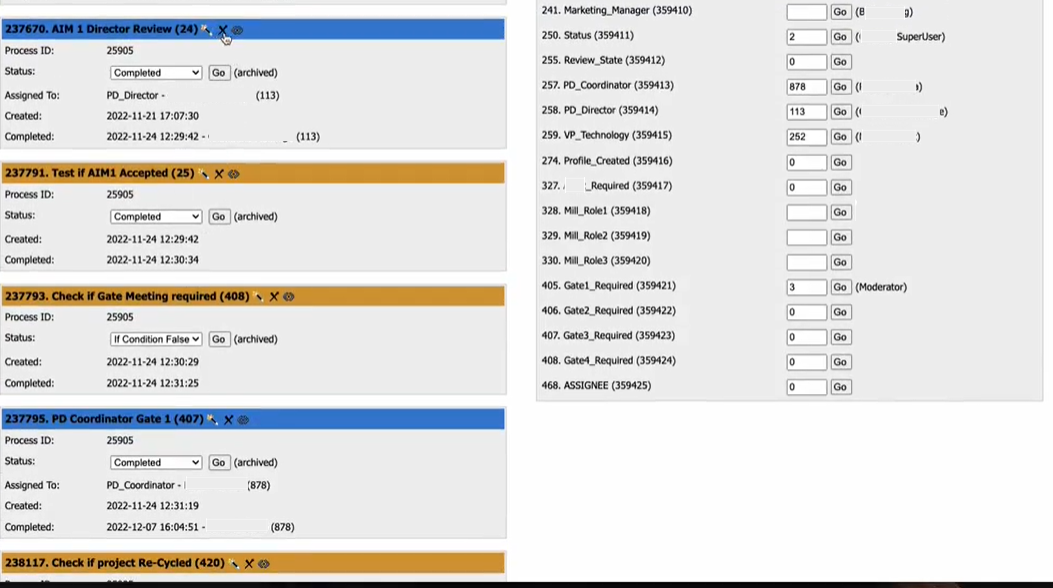
A peek at Maestro’s Template Builder and Trace tool circa 2005.
Through the 2008/2009 Great Financial Crisis, Maestro continued to evolve and automate processes for companies struggling to stay afloat, providing much needed productivity in businesses that couldn’t afford to lose any more money. Many of those businesses which took a chance on using Maestro to automate their processes back then are still in business today and most are still using Maestro for work automation!
Through the peaks and valleys of the business cycle, Maestro has remained laser focused on work automation to offload the mundane day-to-day processes that bog people down. Let your business’ most valuable asset, your employees, do what they do best, and let Maestro handle the shuffling of papers, approvals, signoffs and communication with external parties and systems.
Fast forward to 2026 and Maestro is celebrating its 23rd birthday with an update to the Maestro Engine to support the direction work automation continues to march toward: AI integration.
We released Maestro AI in 2025 which provides AI in a real workflow engine, not just a linear template executor with a fancy front-end. We also have the Maestro AI Agent which is capable of translating your description of what you want a workflow pattern to do and it will create the Maestro Template for you. As was once famously said, “With great power comes great responsibility”, and so it holds true for Maestro. With the ability to generate business processes with AI, you’re able to provide a great deal of power directly into the hands of business owners, analysts and administrators. Maestro must also adapt to how AI generates workflows vs. how humans tend to generate workflows.
Maestro’s Engine Updates in January 2026
Maestro’s Engine update introduces Deep Ancestor Regeneration, a powerful capability that allows workflows to adapt intelligently to evolving business logic, especially in processes generated by AI. Deep Ancestor Regeneration supports looping back to any ancestor in the flow and Maestro figures out which tasks need to be terminated and which can remain active.
When humans create workflow patterns, we tend to think in human-centric ways. Workflow patterns tend to branch off from a parent trunk where potentially iterative work is performed, leaving other branches of work to its own devices.
Take for example an onboarding workflow where a new employee will require finance setup, physical desk space (Including whether the physical space is considered a secure area), a telephone, cell phone, laptop and security card access. If you were to create a workflow pattern to automate that process, it may look something like this:
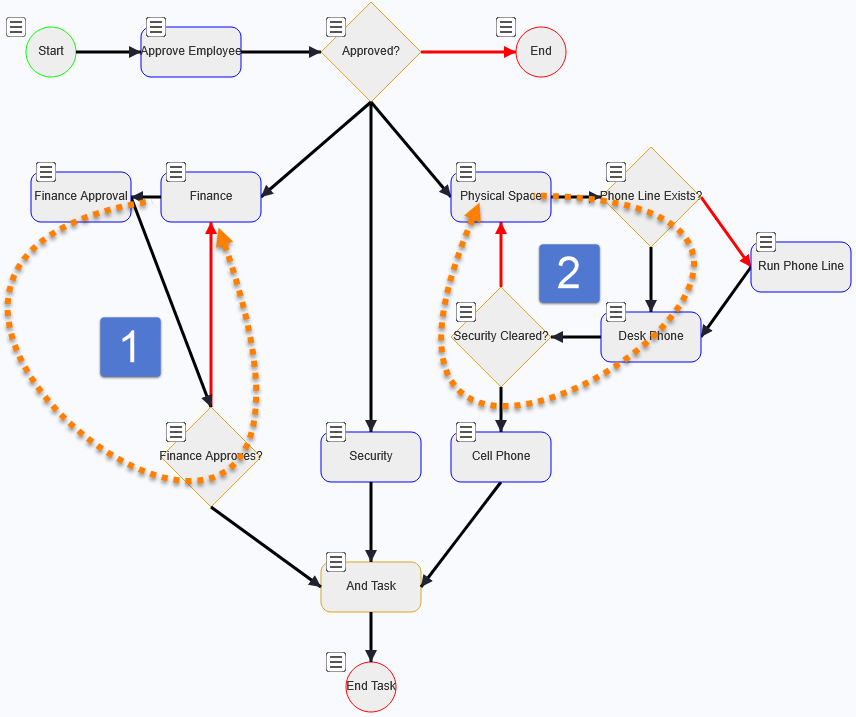
We have an onboarding workflow where once the employee is approved, the Financial creation process may have to go through approval independent of the physical setup of the employee’s workspace. You can distinctly see the loops #1 and #2 where those portions of the process can loop independently until properly completed. Generally, this is how humans create workflow patterns: based on the knowledge they have of their business processes and allowing humans to perform their work in separate branches yet still in the same workflow.
Contrast to how AI generates this workflow with a very explicit instructions telling it what needs to be automated:
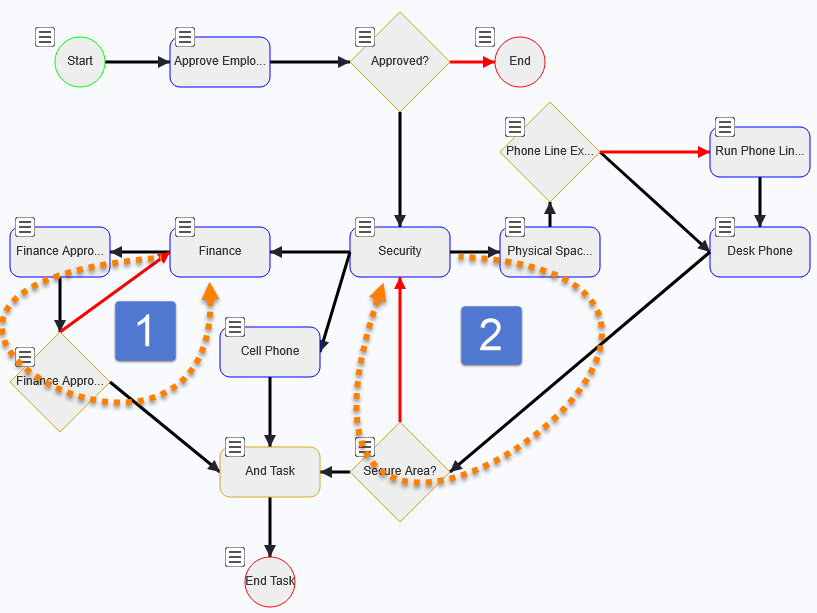
The AI version of the workflow still has a Finance loop process (#1 in the diagram) and a Physical Space and Phone loop process (#2 in the diagram), all “inline” with the Cell Phone creation. Simply put, Finance, Cell Phone and Physical Space execution happens at the same time: after Security Access is complete.
During the Physical Space loop (#2), if the secure area clearance is not met for the physical space, AI has determined that it must loop back to the Security task. If you look closely, the Security task precedes all other potentially open tasks in the workflow. This means that without Security, Finance, Cell Phone and Physical Space setups should not happen or should be redone. This is Deep Ancestor Regeneration. The workflow loops-back to a point well before currently executing tasks exist.
Is the AI flow correct? Perhaps, but perhaps not. This will be up to the workflow and business analysts to determine and is what Nextide helps and educates companies to detect and architect properly. However, the key here is how the loop-back done by AI loops back to a much older ancestor of the workflow template. This is in contrast to the human generated flow that tends to group human tasks based on how the business operates and is a prime example of Deep Ancestor Regeneration and how Maestro out-of-the-box, is capable of managing this type of workflow.
As AI agents are used more, loop-back scenarios can become more atomic. This means looping back to an ancestor so far back in the chain that all tasks that have already been executed must be executed again. Thanks to Maestro’s 23rd birthday update, it now handles all of these complex flow patterns with ease!

